Download New Guide: The 5 Ingredients Hiding in Places You'd Never Expect

7 Hidden Sources of Microplastics in Your Home (and Smart Swaps to Reduce Exposure)

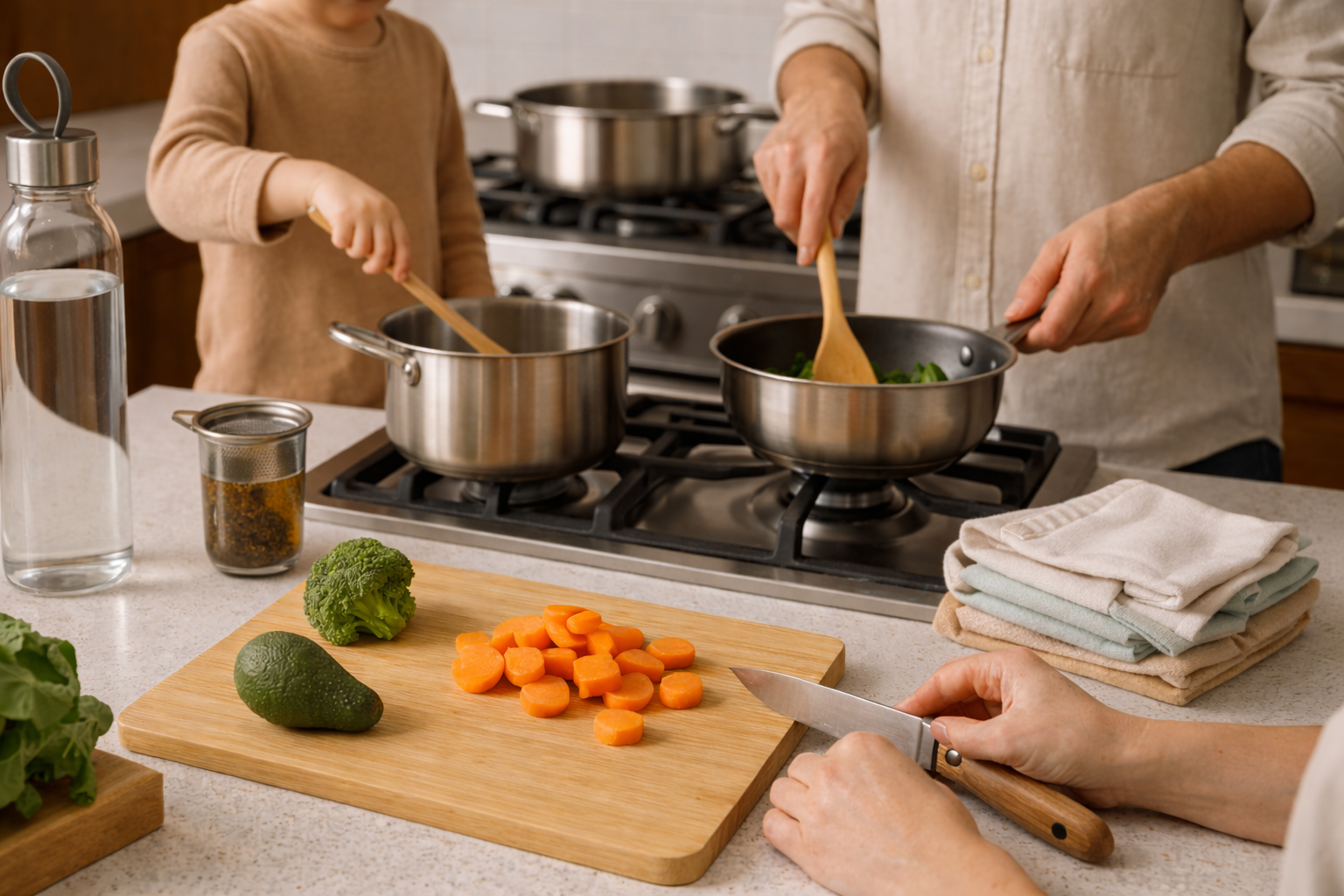
Microplastics are found in places you’d never expect, from your drinking water to household dust. You may be exposed daily without realizing how and where, which makes choosing safer options feel overwhelming. But knowledge is power. As a toxicologist, I’ve mapped out the most important (and overlooked) sources so you can protect your family with confidence – no fear or confusion needed.
Bottled Water: A Surprising Source of Microplastics
Plastic bottled water often appears cleaner or safer than tap. However, did you know that it can contain around 240,000 micro- and nanoplastic particles per liter? That’s more than double what’s found in regular tap water. Heat exposure – like when bottles sit in a hot car or on a sunny shelf, makes plastics degrade even faster, releasing more particles into your water. Opt for glass bottles or a home filter to reduce your daily intake and environmental impact with a single swap.
Non-Stick Cookware: Small Scratches, Big Risks
Those trusty non-stick pans might add more to your meals than flavor. Scratches, often invisible, can send over 9,000 plastic particles per use into your food, increasing to millions if the coating cracks. Instead, choose uncoated cast iron, stainless steel, or solid ceramic for durable, long-lasting cookware that won’t add unwanted chemicals to your family’s food.
Baby Bottles & Food Pouches: Plastics in Childhood Nutrition
Plastic baby bottles and squeezable food pouches can release up to 4 million microplastic particles a day, especially when sterilized or stored long-term. Glass bottles and jars are safer choices during a child’s most sensitive years. Even if you’ve used plastic before, it’s not too late to switch and support your child’s well-being moving forward.
Plastic Cutting Boards: Hidden Additions to Your Chopped Meals
Each cut on a plastic board shaves off tiny slivers that build up in your food over time. Research suggests people could ingest up to 50 grams of microplastics yearly from worn polyethylene boards. Use wood or bamboo cutting boards for a safer, more natural prep surface.
Laundry: Synthetic Fabrics Release More Than You Think
Your laundry routine could be leaking microfibers from polyester, nylon, and spandex into your home and environment. Washing synthetic clothes releases thousands of particles per load. Consider a fiber-catching laundry bag, external filters, or choosing more natural fabrics to reduce this often invisible source of exposure.
Household Dust: Invisible, But Not Harmless
Everyday dust is a cocktail of fibers, including plastic from furniture, electronics, and clothing. Babies and pets, close to the floor, are especially at risk. Wet dusting and using a vacuum with a HEPA filter can significantly decrease indoor plastic dust and improve air quality.
Tea Bags: Check What’s in Your Cup
Many premium teas use synthetic mesh bags, which can release over 11 billion microplastic particles per brew. Choose loose-leaf teas with stainless steel infusers or brands that commit to plastic-free bags. Even small rituals, like your evening tea, benefit from thoughtful upgrades.
Small Changes, Big Impact
Microplastics are everywhere, but you can take practical steps without fear or guilt. Every swap you make, water, cookware, baby products, laundry, cleaning, tea, adds up to greater protection for your family. Start with the swaps that matter most to you and build from there.
Dr. Yvonne’s Plastic Swaps
Links provided on this page are affiliate links, which means if you click on it and make a purchase I may earn commission. The commission comes at no cost to you and allows me to continue my research. Note- I only recommend products that I personally use and/or trust. I will always disclose whether a link is an affiliate link, and never recommend products solely for the purpose of commission.
References
- Environ. Sci. Technol. 2023, 57, 22, 8225–8235
- Hussain KA, Romanova S, Okur I, Zhang D, Kuebler J, Huang X, Wang B, Fernandez-Ballester L, Lu Y, Schubert M, Li Y. Assessing the Release of Microplastics and Nanoplastics from Plastic Containers and Reusable Food Pouches: Implications for Human Health. Environ Sci Technol. 2023 Jul 4;57(26):9782-9792. doi: 10.1021/acs.est.3c01942. Epub 2023 Jun 21. PMID: 37343248.
- Matthew Cole, Alessio Gomiero, Adrián Jaén-Gil, Marte Haave, Amy Lusher, https://doi.org/10.1016/j.scitotenv.2024.172577
- Luo Y, Gibson CT, Chuah C, Tang Y, Naidu R, Fang C. Raman imaging for the identification of Teflon microplastics and nanoplastics released from non-stick cookware. Sci Total Environ. 2022 Dec 10;851(Pt 2):158293. doi: 10.1016/j.scitotenv.2022.158293. Epub 2022 Aug 27. PMID: 36030853.
- Ali T, Habib A, Muskan F, Mumtaz S, Shams R. Health risks posed by microplastics in tea bags: microplastic pollution – a truly global problem. Int J Surg. 2023 Mar 1;109(3):515-516. doi: 10.1097/JS9.0000000000000055. PMID: 36927815; PMCID: PMC10389239.
- Zhang J, Wang L, Kannan K. Microplastics in house dust from 12 countries and associated human exposure. Environ Int. 2020 Jan;134:105314. doi: 10.1016/j.envint.2019.105314. Epub 2019 Nov 19. PMID: 31756678.
- De Falco F, Di Pace E, Cocca M, Avella M. The contribution of washing processes of synthetic clothes to microplastic pollution. Sci Rep. 2019 Apr 29;9(1):6633. doi: 10.1038/s41598-019-43023-x. PMID: 31036862; PMCID: PMC6488573.
- Akyildiz SH, Fiore S, Bruno M, Sezgin H, Yalcin-Enis I, Yalcin B, Bellopede R. Release of microplastic fibers from synthetic textiles during household washing. Environ Pollut. 2024 Sep 15;357:124455. doi: 10.1016/j.envpol.2024.124455. Epub 2024 Jun 26. PMID: 38942274.
- https://www.nih.gov/news-events/nih-research-matters/plastic-particles-bottled-water
- Qian N, Gao X, Lang X, Deng H, Bratu TM, Chen Q, Stapleton P, Yan B, Min W. Rapid single-particle chemical imaging of nanoplastics by SRS microscopy. Proc Natl Acad Sci U S A. 2024 Jan 16;121(3):e2300582121. doi: 10.1073/pnas.2300582121. Epub 2024 Jan 8. PMID: 38190543; PMCID: PMC10801917.