You’re swapping parabens, using glass food containers, and staying vigilant with ingredient lists. But did you know your healthy habits might still be undermined by a hidden source: canned foods and plastics? I’m Dr. Yvonne Burkart, PhD, toxicologist and mom of two, here to unpack what most health-conscious readers never hear about hormone disruptors in everyday foods and storage containers.
Why Clean Living Isn’t Always Enough
You eat organic, filter your water, and reject plastics. Still, something feels off. Many women doing everything “right” still face unexplained fertility struggles or irregular cycles. If you’ve ever felt that way, you’re not alone, and the culprit may be more invisible than you think.
The Overlooked Danger in “BPA-Free” Labels
Hidden in the lining of nearly all canned foods, even those labeled BPA-free, are bisphenols. While BPA has earned a bad reputation, its chemical cousins (like BPF and BPS) are now commonly used instead. Their structures are strikingly similar and, according to recent studies, can be just as disruptive, or worse, for reproductive health.
- Can linings release bisphenols into your food, especially when food is acidic, fatty, or heated.
- Bisphenols target ovarian follicles, specifically granulosa cells, disrupting hormone production and egg maturation.
- Damage to these cells means compromised egg quality and fertility, even if you look healthy “on paper.”
Plastics, Phthalates, and Food Storage: What You Need to Know
Beyond cans, everyday plastic wraps, bags, and soft containers often contain phthalates, plasticizers known to migrate into food, especially when it’s fatty or heated. Even at room temperature, they pose a risk over time.
- Continuous exposure to phthalates is linked to reduced ovarian reserve and lower IVF success rates.
- Heating food in plastic containers (via microwave or hot leftovers) increases chemical leaching. This includes microplastics now detected in placentas and infants.
- Oxidative stress and hormone disruption from these chemicals can directly impair fertility outcomes.
Why IVF and Plastic Don’t Mix
During fertility treatments, ovarian follicles become even more vulnerable to toxins. Studies show that even low-dose exposure to BPA or phthalates can result in fewer mature eggs and lower embryo quality. Sensitivity increases during ovarian stimulation, making chemical avoidance even more critical.
Practical Swaps for Maximum Impact
Fertility-friendly living isn’t just about what you add. It’s about what you remove. Here are science-backed swaps that matter most:
- Choose dry beans, frozen produce, or beans in glass jars (like Jovial brand) over canned goods, even if labeled BPA-free.
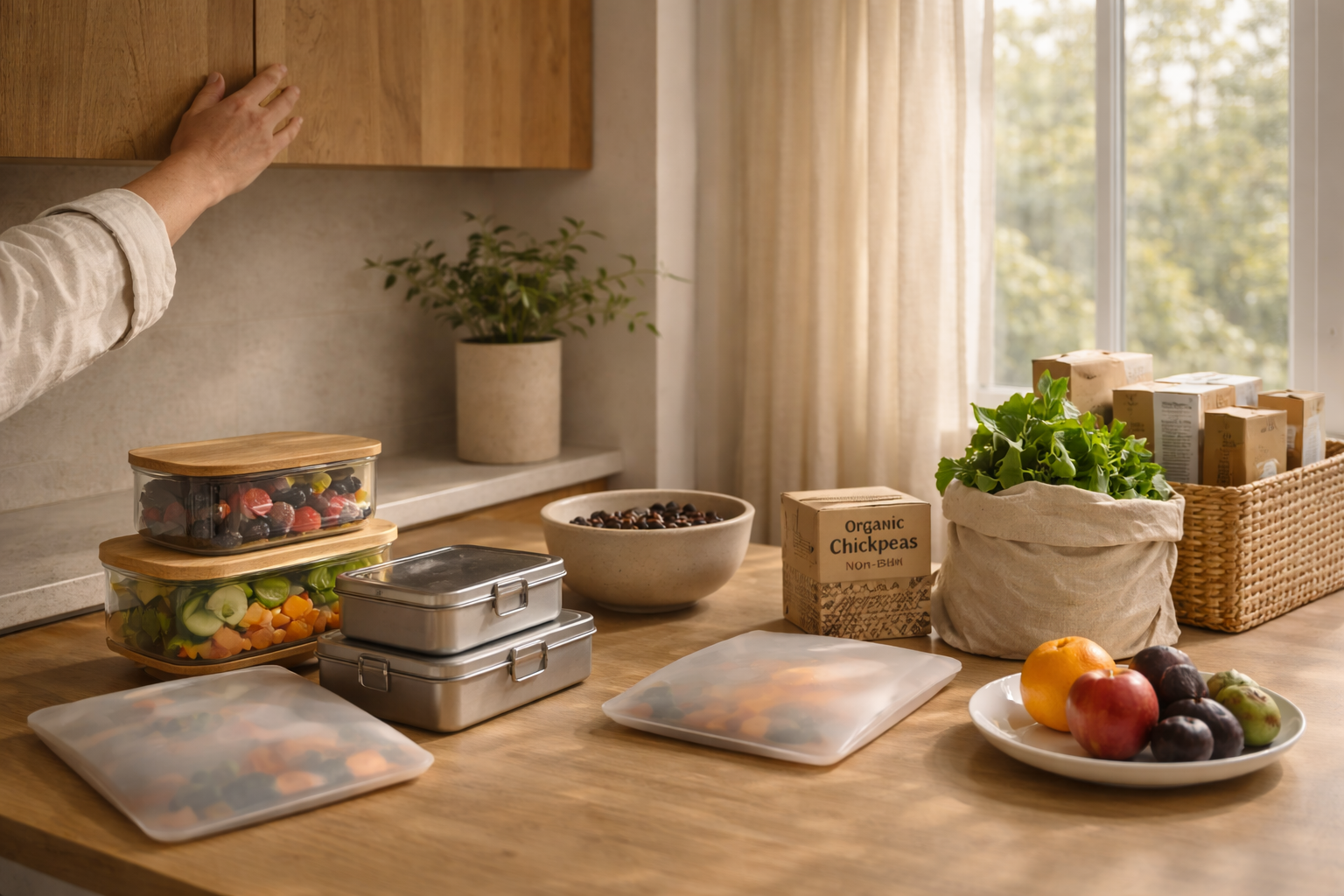
- Store leftovers in glass, stainless steel, or unheated silicone. Never heat food in silicone or plastic.
- Be skeptical of “BPA-free” and other claims. If it’s plastic, especially soft plastic, it likely leaches chemicals.
The Big Picture: Consistency Over Perfection
Your hormones and fertility benefit more when you consistently avoid bisphenols and phthalates, rather than striving for impossible perfection. Start with simple changes to how you store and prep food. Removing the right exposures is more potent than piling on supplements or superfoods.
References
- Hoang YD, Nakamura BN, Luderer U. Follicle-stimulating hormone and estradiol interact to stimulate glutathione synthesis in rat ovarian follicles and granulosa cells. Biol Reprod. 2009 Oct;81(4):636-46. doi: 10.1095/biolreprod.109.078378. Epub 2009 Jun 10. PMID: 19516019; PMCID: PMC2754881.
- Celar Šturm D, Režen T, Jančar N, Virant-Klun I. Bisphenol a Disrupts Steroidogenesis and Induces Apoptosis in Human Granulosa Cells Cultured In Vitro. Int J Mol Sci. 2025 Apr 25;26(9):4081. doi: 10.3390/ijms26094081. PMID: 40362320; PMCID: PMC12071243.
- Rochester JR, Bolden AL. Bisphenol S and F: A Systematic Review and Comparison of the Hormonal Activity of Bisphenol A Substitutes. Environ Health Perspect. 2015 Jul;123(7):643-50. doi: 10.1289/ehp.1408989. Epub 2015 Mar 16. PMID: 25775505; PMCID: PMC4492270.
- Begum TF, Fujimoto VY, Gerona R, McGough A, Lenhart N, Wong R, Mok-Lin E, Melamed J, Butts CD, Bloom MS. A pilot investigation of couple-level phthalates exposure and in vitro fertilization (IVF) outcomes. Reprod Toxicol. 2021 Jan;99:56-64. doi: 10.1016/j.reprotox.2020.11.014. Epub 2020 Nov 30. PMID: 33271283; PMCID: PMC7897280.
- Hu W, Jin Z, Wang H, Wang F, Qu F. Relationship between phthalates exposure, risk of decreased ovarian reserve, and oxidative stress levels. Toxicol Ind Health. 2024 Apr;40(4):156-166. doi: 10.1177/07482337241229761. Epub 2024 Jan 29. PMID: 38284240.
- Wang P, Li G, Shou H, Huang X, Xu H, Zhang S, Zhu H. Microplastic abundance in placental chorionic villi detected by pyrolysis-gas chromatography/mass spectrometry in cases of spontaneous miscarriage during early pregnancy. EBioMedicine. 2025 Oct;120:105918. doi: 10.1016/j.ebiom.2025.105918. Epub 2025 Sep 18. PMID: 40972227; PMCID: PMC12478273.